[QUICK NOTE: It's been hard to hear about the absolute destruction going on in the Philippines right now. If you're looking for ways to help, World Vision International is currently launching their relief response. They're a great organization that focuses on the well being of communities, especially kids. If you can help out at all, please check out http://www.worldvision.org/news-stories-videos/typhoon-haiyan-response-philippines.
Thanks for your time! -Brett]
We arrived in the evening, passing by boutique hotels, Bohemian cafes, and a relaxed nightlight environment as our tuk-tuk dragged along toward our hostel. Exhausted from protesting scams and two days spent on the Mekong River, we had a chilled-out night with a couple of Lao beers. We needed our energy - the next few days in Luang Prabang would be about exploring this side of Laos to the fullest extent.
A Cascading Paradise
The next morning, with the day essentially unplanned, Chloe, Harry and I joined up with a group from our hostel headed for the Kuang Si waterfall. I ended up riding shotgun in an overcrowded van, which ended up driving for about 45 minutes through a winding mountain road. While it may not have been the best trip for my motion-sickness-prone stomach, once arriving at Kuang Si, any loss of breakfast that may or may not have occurred on the way there was soon forgotten.
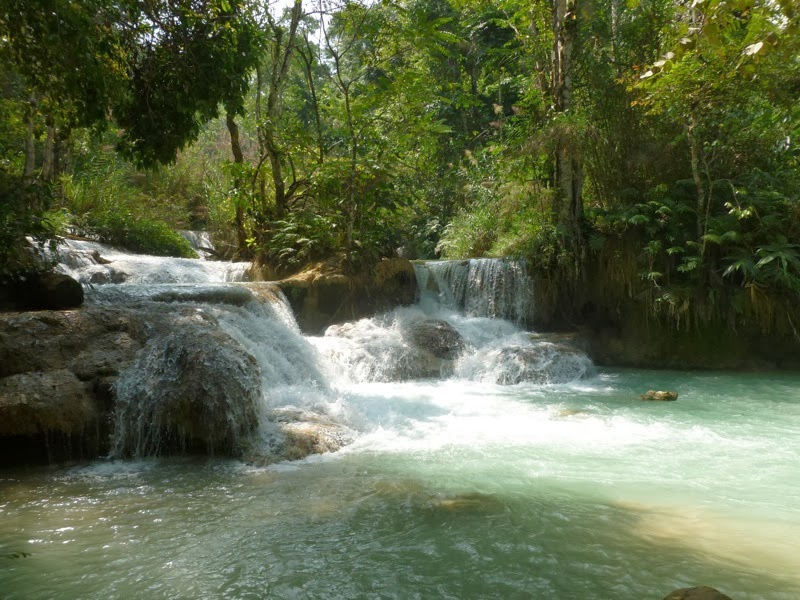
After passing through a random bear sanctuary, I was soon looking at aqua blue pools, flowing down into one another through a series of beautifully terraced waterfalls. Housed within a tranquil jungle canopy, each pool beamed with bright blue colors, in a surreal display of the most inviting, natural swimming pools I've ever encountered.
Floating and drifting against the currents, I found a half-submerged tree on which I could take it all in from. The water was pure, the air was clean, and there was really nothing else to do with the day except enjoy the swimming. The drive down proved to be much more tolerable for my weak stomach, and I was able to notice the pure beauty of the mountain countryside surrounding Luang Prabang.
Head for the Hills
While towns like Luang Prabang provide the sights and charms that so many people search for when traveling through Southeast Asia, to truly experience the unvarnished, raw beauty of Laos you've got to take your comfort zone to the next level and step away from the air conditioned guesthouses and chic backpacker pubs. To me this meant getting out of Luang Prabang for two days, and joining a trek into the surrounding highlands.
After a banana pancake breakfast, Chloe, Harry and I got picked up by a van around 8:30 a.m, driving for about an hour into the hills until we arrived at a small village that would serve as our trailhead.
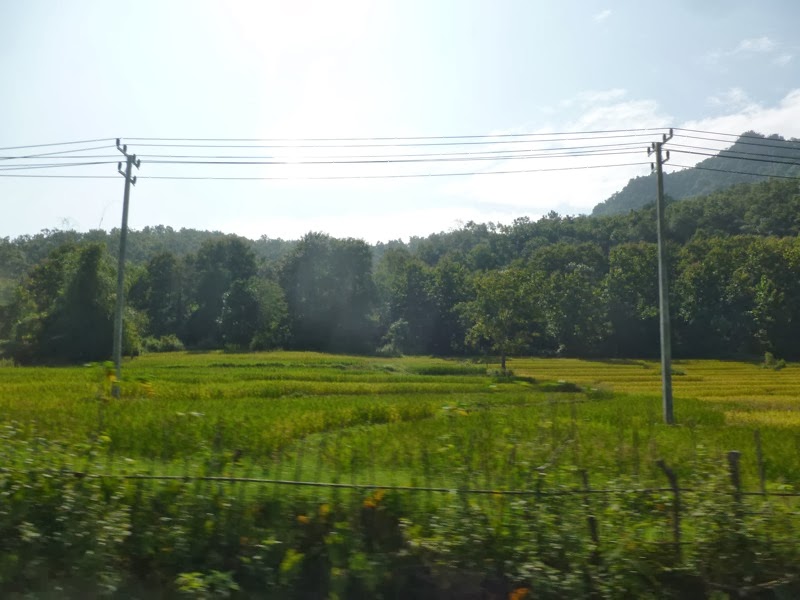
The three of us geared up for a day of hiking, we followed out guide Lee through a winding, muddy path that took us further and further away from the village, and into a landscape of green and gold beauty. The greens of the jungled foothills melded with the golden hues of the terraced rice fields in a harmonious meeting of natural growth and human cultivation.
A few hours into the trek, after a lunch break of fried rice and cucumbers, Lee took us into a Hmong village nestled inside the isolated valley of jungle and rice fields. The Hmong are a minority ethnic group in Laos who predominately lead lives centered on subsistence agriculture, within the innumerable hillsides of rural Laos. In the first Hmong village we came across, mothers and children were quietly resting away the day, while dogs, pigs, cats, chickens and cows went about their daily business inside and outside the village.
Continuing our climb up the valley wall, I looked outward across the valley, where a blue sky covered a quiet, peaceful community of people living in harmony with their wildly remote environment. It was a hot, sweaty climb to the top, but didn't really have time to be uncomfortable - the air around me was too clean, and sights below me were too beautiful.
At the conclusion of our ascent, we arrived at another Hmong village, slightly larger than the first, and teeming with a little more life. Passing the two-room school and lone general goods shop, we sat down inside our bungalow for the night.
Nightfall came quickly, and we ate a candlelight dinner of rice and veggies. The stars above reminded me how far away I was from boulevards, traffic jams and crowded sidewalks. The mountain air and peaceful solitude of the Laotian hills breathed a pure rejuvenation of total oneness with God's immense and unfathomable Creation that night.
All was well.
Down the River
The descent naturally took less than half the time we used to get up to the valley's edge. A couple of hours hiking got us back to our original trailhead, where our van picked us up once again, this time taking us downhill to the Nam Ou River. We hopped out of the van, where we saw our next mode of transportation for the day: kayaks.
After an easy launch, we floated downstream, the gentle current doing most of the work. The Nam Ou cuts through the countryside much like the Mekong, walled by towering jungle trees, hanging over the shoreline. Following a quick lunch of friend rice and bananas, we jumped back in the kayaks and floated down to our first significant river challenge. The Nam Ou eventually dumps into the much larger Mekong River - we were right at that confluence with nothing but our dinky, rented oars to get us across the mighty Mekong.
Aiming about 50 meters upriver, we started our crossing; I immediately felt the uninhibited, raw strength of fresh water fury as soon as my kayak entered this tricky junction of streams. The 50 meter target proved accurate. We pulled up on the opposite shore of the Mekong, right at our intended destination - the Pak Ou Caves.
Long used as Buddhist shrines, the caves gaze outward toward the confluence as a sort of guardian to the unrelenting forces of the Mekong. We stayed just long enough to give our rowing muscles a break, then boarded our kayaks one more time for our final destination: elephants.
Pachydermia
Cautiously letting the Mekong do most of the work, I gently guided my kayak back across the river, to a landing about one kilometer downstream. The smell gave it away pretty quickly - it was was clear that elephants were nearby.
Sure enough, as we landed our boats and climbed up the riverbank, the land-mines laid by these beasts eventually led to the animals themselves. About four elephants waited for us, eating away at the local greenery in quantities incomparable to any other creature found on land.
Well, highly domesticated (for better or for worse), these super relaxed elephants were clearly used to human interaction. Chloe, Harry and I hopped on for a ride, and my first thought was - I'm going to fall off of this thing and break my neck. The closest experience I've had to riding an elephant before this was riding a horse - not even close to being the same thing. Fortunately, neck-breaking didn't happen, and I even managed not to fall off at all, somehow. Overall, it was quite the experience.
It was comforting to see how the handlers treated the elephants during the riding. No beating or whips needed, just a few verbal commands. Our elephant looked like she was in good shape - she certainly had an appetite for bananas.
After a miniscule snack of about three whole bunches of bananas, it was bath time. The elephants followed us all down to the Mekong riverbank jumped right in for a nice cool-off. We were invited to join them, but feeling less than eager for Cholera or a Mekong parasitic infection, I opted to watch from the shore.
Luang Prabang will always be a special place to me because of this trek. The picturesque scenes, and the quiet beauty of this side of Laos will forever be in my memories.
[QUICK NOTE: It's been hard to hear about the absolute destruction going on in the Philippines right now. If you're looking for ways to help, World Vision International is currently launching their relief response. They're a great organization that focuses on the well being of communities, especially kids. If you can help out at all, please check out http://www.worldvision.org/.../typhoon-haiyan-philippines Thanks for your time! - Brett]
My time in northern Thailand was winding down. Looking eastward on the map, I planned my journey into a country that I knew very little about. Laos doesn't have beaches. It doesn't have the blaring tourist magnets of Thailand, Vietnam or Cambodia. There is no Angkor Wat or Ha Long Bay here. But somewhere between the French baguettes, turquoise waterfalls, and the golden rice terraces of isolated hill tribes, lie the hidden charms scattered about this Communist outpost of 6.5 million people.
From Thailand to Laos in a Day
My plan was to cross the Mekong River from Thailand into Huay Xai, Laos, where I would then begin an overnight boat journey to Luang Prabang - the heart of northern Laos.
This two day endeavor would first take me from Chiang Rai, Thailand by bus, where I would then cross the Mekong on a ferry into the Laos border town of Huay Xai. From Huay Xai, a slow boat would take me half-way to Luang Prabang, to a tiny little village called Pak Beng. After spending the night in Pak Beng, and another seven or eight hours on the slow boat, I'd arrive in Luang Prabang.
Splendid Views, Cockroaches, and the Tuk-Tuk Mafia
The local bus ride from Chiang Rai to the border town of Chiang Kong was uneventful, minus driving past a scene where a shirtless Thai man, armed with a club, was caught in a battle-royal with some kind of snake; so, for about five seconds we drove past a snake being beaten to death by a tree branch. Just another day in rural Thailand, perhaps.
Apart from witnessing snake murder, I met up with Chloe and Harry, a British couple also traveling on the route to Luang Prabang. The three of us were the only foreigners on this local bus - it's remarkable how much solidarity can immediately exist between fellow backpackers on the road. Within ten minutes we had made plans for staying together in Huay Xai, and figuring out the boat situation together.
In Chiang Kong, after a brief passport stamping and ferry ride, we found ourselves in Laos, looking back across the Mekong into Thailand. Visas purchased and stamped, we found a place to stay for a little over one dollar each.
That evening, we happened to arrive in the middle of a local Buddhist festival, complete with floating lanterns, deafening Lao pop music, and fiery boat sacrifices sent down the Mekong. Naturally, we bought a lantern to set into the night sky (narrowly avoiding power lines on the way up) and Harry set off about four roman candles in a row. All in all, it was a nice introduction to Laos.


The next morning, it was time - time to head down to the boat docks and find our ride for the next two days. Almost completely unsure of what to expect, I was happy to see a decently new-ish looking longtail boat, with a roof, and furnished with what looked like ex-passenger airplane seats. Full of about 95% foreigners, we crammed into this thing until the captain was satisfied, and we were soon off down the Mekong. The sights from my window seat became more and more wild as we drifted away from the Thai border, into the isolated jungles of rural Laos. Conrad's Heart of Darkness immediately came into my mind, as we seemed to slip further and further into the void.
The broadening waters flowed through a mob of wooded islands; you lost your way on that river as you would in a desert, and butted all day against shoals, trying to find the channel, til you thought yourself bewitched and cut off forever from everything you had known once - somewhere - far away in another existence perhaps. There were moments when one's past came back to one, as it will sometimes when you have not a moment to spare yourself; but it came in the shape of an unrestful and noisy dream, remembered with wonder amongst the overwhelming realities of this strange world of plants, and water, and silence.


Seven hours, no less than seven hours later, we pulled into our harbor at Pak Beng, the overnight stop on the way to Luang Prabang. It's hard to put into words how much nothingness characterized Pak Beng. Almost exclusively supported by the guesthouses catering to this exact boat route, the town had one street that simply ended at a wall of jungle. For me, it was perfect. I briefly contemplated staying an extra day or two, until at that exact moment, the town's electricity cut out for the night. You can't have everything in the middle of nowhere.
We did, however, manage to find clean beds and running water for about $0.75 for the night. Everything seemed horribly underpriced, until at about 1 a.m, a scream from Chloe revealed a human hand-sized cockroach crawling from wall to floor in about two seconds. Heroics from Harry and I got the foul beast out of the room. It's safe to say that our hopes at getting sleep died soon after the cockroach incident.
A lazy morning relegated us to the back of the boat for day two, but the unending beauty of the scenery outside was more than enough to keep me happy.
Eight hours later, the engines stopped and we pulled over to a sign labeled "LUANG PRABANG COUNTY." I'd read up quite a bit about this scam online, so I wasn't too surprised to see it actually happening. Located about 10-20 kilometers outside the city itself, the captain would park his boat here so that the local tuk-tuk "association" could benefit from all of the tourists paying to get into town.
Harry, Chloe and I were joined by about eight others in protesting the scam. We wanted to go into town, where we had paid to get to. Unfortunately, eight out of about eighty wasn't enough to influence anybody, so after about 20 minutes waiting in vain, we paid the $3 each and eventually made it into Luang Prabang. It was a disheartening, but very real reminder that as foreign tourists, we were targets for any kind of financial milking possible. Fortunately, the bummer that was paying into the tuk-tuk scam soon faded away, as I found myself in one of the true gems of Southeast Asia: Luang Prabang.
Bangkok's northern bus station was swarming with activity, and I was immediately caught off guard by the sheer masses of people going to and from every direction of the terminal. I had a ticket for an overnight bus, which spanned the 750 kilometers between Bangkok and Chiang Mai in a supposed nine hours. I stocked up on Thai junk food from the 7-11, and eventually sat down in my bed for the night, toward the front of the bus.
Cruising north out of the city, and drifting in and out of sleep, I didn't really mind spending a night like this - apart from the ungodly-cold air conditioner which blasted frozen air directly on my face for nine and a half hours, and could not be turned off. While I might have expected to catch any number of diseases or medical conditions during my time in Southeast Asia, hypothermia was not one of them. I think I came close to it during that bus ride.
Groggy from the half-sleep I got, and befuddled by the lack of general directions to anything, I stumbled out of the bus into the Chiang Mai bus terminal around 8 am. After a bit of obligatory haggling, I found a cheap ride into the city via songthaew, and I soon arrived at Diva Guesthouse, my base of operations for my four days in Chiang Mai.
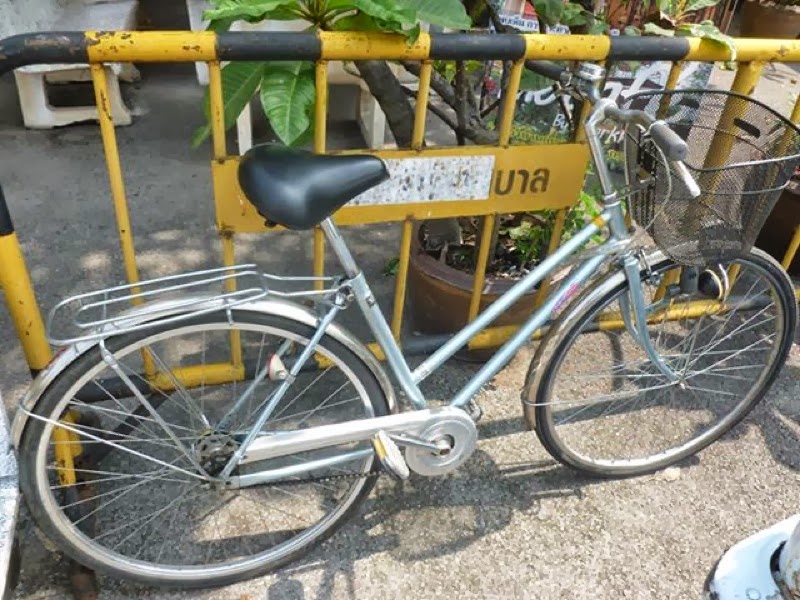
The next morning, after a fresh, hot Thai breakfast soup, I rented a bicycle and began my self guided tour of the old city. Chiang Mai was originally housed within a square shaped wall, and protected by a moat. While the moat is still full of water, most of the wall has deteriorated over time. Most of the city's history can be seen within the boundaries of the wall, which is entirely bike-able.
Ancient temples (wats) are sprinkled throughout the old city, each with its own unique qualities and histories. Wat Chiang Man is one of the oldest, and exudes golden rays from it's regal exterior, while the stoic Wat Chedi Luang has crumbled a bit, but offers a window straight into the past of Chiang Mai.
That evening, I walked outside of the old city to another keystone Chiang Mai attraction: the night bazaar. Selling pretty much anything Thai you could imagine, vendors of every variety set up camp along the rows and rows of streets set aside for the bazaar.
The following morning, I decided it was time to upgrade my bicycle into something with a little more muscle. I set aside any anxieties I had about driving on the left side of the road, and rented a 125cc scooter for the day.
Taking it very, very slow at first, I gained enough confidence to take this bad boy up into the hillside for an amazing 1 hour drive up Doi Suthep mountain. The winding mountain road eventually arrived at Wat Doi Suthep, perhaps the pinnacle of Chiang Mai's temple scene.
Incense burned, traditional Lanna music flowed through the air - it was a peaceful place, despite the hundreds of visitors swarming about it.
Down the mountain I went, to a baguette sandwich lunch. I spent the rest of the afternoon cruising around the old city in my new ride, snapping photos and stopping for street-side snacks.
At this point, I had already decided to extend my stay in Chiang Mai. The city was too beautiful, the people were too friendly, and the food was simply too damn delicious to leave after just three days. I planned a mountain bike trip for the next morning, and reserved the following day for any unfinished sightseeing.
The next day, an early morning ride in the back of a pickup truck took me to my mountain biking adventure, back at the top of Doi Suthep. The road got smaller and smaller as we climbed, until eventually, it became dirt, which eventually became single-track - a mountain biking paradise.
Geared up and ready for adrenaline, I began my two hour descent, as the tropical greenery flew past beside me. The trail was a perfect blend of single and double track, while the surface was perfectly moist and free of any major annoyances.
My descent finished at the side of a lake, where a bungalow was waiting for me with ice cold water and red curry chicken. It was my nirvana moment of the week, for sure.
That evening, after a tranquilizing Thai massage, I walked over to Chiang Mai's North Gate Jazz Co-op - one of the coolest music venues I've seen anywhere. A five-man Thai group absolutely killed it with their set, blending modern jazz grooves with their expert saxophone lead.
The following day, my last in Chiang Mai, I needed to see a few more markets and temples before I felt at least somewhat o.k. about my brief time in Chiang Mai. Bypassing the hordes of foreign tourists at the main markets east of the old city, I instead biked up to a local market, mostly hidden from the main street.
This market had no English signage, and remarkably, no other foreigners that I could see. To me, this meant that the food would be worth trying - and it certainly was. I walked into the market hungry and thirsty, and walked out of it full of pork curry and a mango smoothie.
The local markets of Chiang Mai are first and foremost places of business. While I was simply some random "farang" (foreigner) snapping photos, mothers, fathers, aunts and uncles were busy selling their produce to everyday folks.
As I walked further into the wholesale market, the street got dirtier and wetter with mystery seafood fluids and I realized, regrettably, that this is probably not the venue for sandals. Nonetheless, I pressed on, pretending not to feel the black sludge on my toes.
Fruits and veggies of every shape and color were offered cheaply, and by the bundle. I stopped for the compulsory bag of fresh pineapple chunks, and biked out of the busy market.
For me, Chiang Mai, will always be a special, special place. Nowhere have I experienced such history, culinary delight, and kindness from locals like I did in this place. The smells of incense and Thai curry remains fresh in my memory, and I hope to be back for another round of street noodles sometime soon.