Monday, October 14, 2013

The Journey Home: An Introduction

When the day finally came, it came fast. Very fast. It was October 8, 2013 - exactly one year after I had began my life as an English teacher in South Korea.

The medley of emotions came and went, and for me, it was time for me to grab my backpack and head out into further unknowns. The door had finally opened to a place that has consistently held it's spot at the top of my travel wish-list: Thailand.


But after just a few minutes into planning, I thought, "Why not extend this thing out a bit?"

Why not visit a few other places on the way?

Months of wishful planning gave way to the reality that I could actually pull this off.


Using the materials I'd collected during a year's worth of daydreaming, I settled on a basic itinerary that involved destinations in Thailand, Laos, Cambodia and Hong Kong.


Beginning my journey in Bangkok, I'll loop around the heart of Southeast Asia, checking out sites in northern Thailand before crossing the land border into Laos. Once I'm in Laos, I'll work my way to the southern border, and cross into Cambodia. After checking out Phnom Penh and Ankor Wat, I'll hopefully find myself in Bangkok once again for my flight to Hong Kong. I'll wrap up my adventure with a few nights in Hong Kong, and soon enough, I'll be back in the U.S


With an open calendar, and my 65 liter REI pack, I jumped on the next plane to Bangkok. My 40 day escapade in Southeast Asia is underway.

Tuesday, October 8, 2013

DMZ: 판문점

There are few places on Earth that are truly frozen in time - places untouched by the decades, where the world of the 21st century has moved on and left the past behind. While new technologies, ideas and innovations have swept over South Korea during the last 50 years, one place has remained bitterly unmoved - fiercely unchanged for over a generation:

The DMZ.


This is the 4 kilometer wide, land mine-filled, barbed wire fenced, Demilitarized Zone - the tense, uncomfortably quiet buffer zone between North and South Korea. What began with an uneasy armistice agreement in the 1950s has remained remarkably the same over the years. The crosshairs of two countries, torn apart by political divide and external rivalries, have remained ceaselessly pointed at one another across the quiet, deceptively tranquil countryside surrounding the DMZ.

While you wouldn't know it whilst shopping at the luxury boutiques of Gangnam, only 90 minutes away, South Korea is still technically at war with its northern enemy. That's right. The 1953 armistice agreement nominally ended the bloody conflict, but did not officially dissolve the conflict. A product of negotiations between the U.S, South Korea, North Korea, China, the DMZ was established as a buffer zone between the two states on the Korean peninsula.

60 years later, I found myself staring into the fringes of North Korea, in the United Nations Joint Security Area (JSA). 


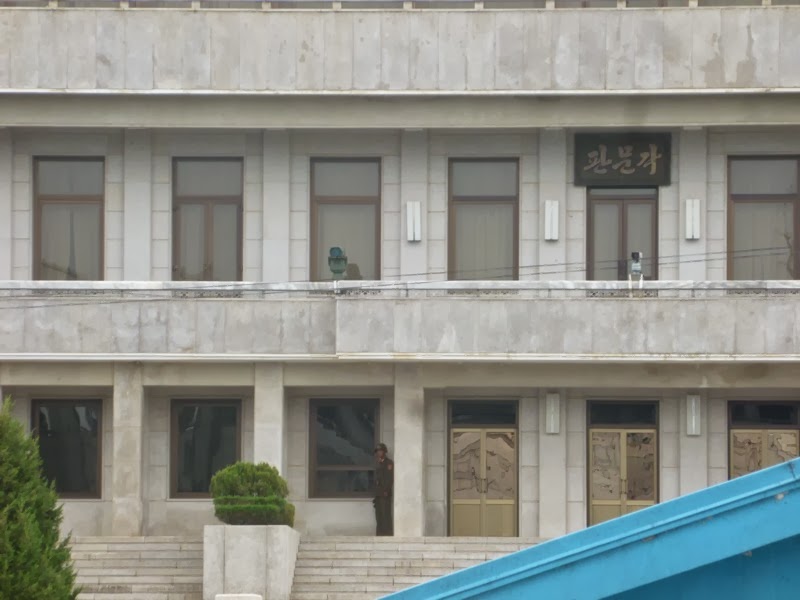
The JSA, dually administered by the North and South (as well as a battalion from the United States), is the epicenter of activity within the DMZ. Concurrently referred to as 판문점 (Panmunjom), these were the little blue buildings I'd seen a dozen times on CNN.


Negotiations between North and South have intermittently taken place since 1953, inside these modestly furnished huts. As I stepped beside one of the conference tables, my tour guide informed me that I had just stepped into what is technically North Korean soil. Half of the conference room is devoted to the South, while the other half is given to the North. My curiosity burned as I peeked out of the foggy windows into what has to be the world's most secretive state.


After about ten minutes within the conference area, as the stone cold, statue-like guards stood watch, I stepped pensively and carefully back toward our entrance. As I looked back, across the divide, I saw one North Korean soldier, staring unshakably into our tour group with a pair of oversized binoculars.


Who is he? What's his name? What's his life like? What does he think about the world outside of the DMZ? These are questions I'll never know the answer to, but questions that rushed through me as I walked away from the JSA, each step taking me back into the 21st century, and back into the world that has seemed to turn the intentional blind eye to this decades-old relic of a long-forgotten war. 

Sunday, September 29, 2013

On Holiday: Gangwon-do 강원도

If you look hard enough, amidst the city sprawls and trendy department stores blanketing the horizon of ultra-urbanized South Korea, you discover an entirely different world. This is the world of rolling, pine-covered hills, blue skies, and unsullied beaches. Taking the place of waves upon waves of cookie-cutter apartment blocks, you see a shoreline of nothing but sand and sea. The surrounding limestone hills rise, crested in misty blankets, carving out valleys of fresh air and untouched greenery. This, is Gangwon-do.

Before heading out for my Chuseok holiday, many of Korean friends ask, "Why Gangwon-do? Don't you want to go to Seoul or Busan?"


There are no towering skyscrapers in Gangwon. There is no Fifth Avenue. This isn't the trend-setting glamor of Gangnam or Hongdae. But unlike the overcrowded beaches of Busan, or the endless asphalt of Seoul, Gangwon-do has a unique charm that can only be found in the raw beauty of its land, and the warmth of its people.


When the Chuseok holiday arrived this year, my fellow English teachers and I were gifted a five-day weekend away from work. While the masses headed to popular destinations like Jeju and Busan, my friends and I boarded our Wednesday morning bus for Gangneung, a beach town in the central coast of Gangwon-do. After some mild confusion and a complimentary van ride, we arrived at Gangneung Guesthouse, just a few hundred steps from the cleanest beach I've ever seen, Korean or otherwise.


We followed up a relaxing afternoon in the sand with a feast of seafood stew and beach-side beers - and a celebratory amount of Chuseok fireworks.

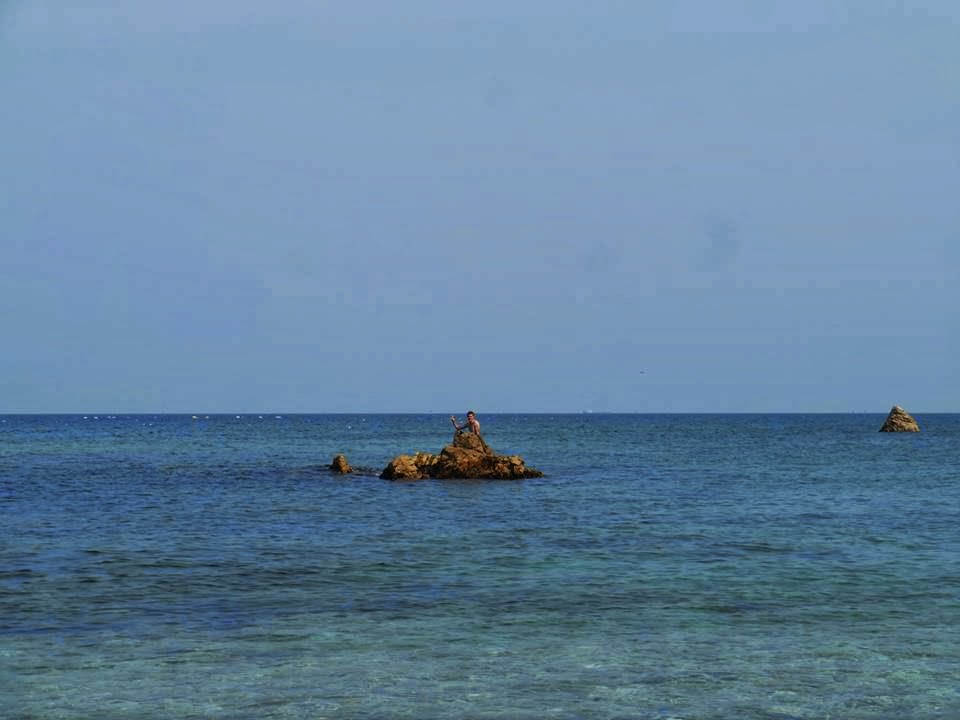
Unlike their Busan counterparts, the beaches of Gangwon-do offer space for true relaxation. Gangneung's beaches offer the same crystal blue water, stretching out into the open Pacific, but delightfully lack the swarms of humanity that have taken over Haendae beach in Busan. 


No thanks
My beachside nirvana continued through the afternoon - long enough to pick up a sunburnt face for a souvenir - as evening made its way into Gangneung. We headed for the rooftop of our guesthouse, where our gracious host was grilling away giant slabs of Samgyupsal - the quintessential Korean barbecue experience. 

Our rooftop feast continued into the night, sharing pieces of masterly prepared pork belly with friends, and washing it down with cheap, but cold beer. For me, it was a farewell celebration for summer - a time on the calendar where one season ends, and another begins, when we enjoy the flavors, sights, sounds and smells of both in a toast to what the summer was, and what the next few months will be.


Our time in Gangneung had come to end, and it was time to head down the coast of Gangwon-do to our next destination: Samcheok. 

Bussing through the mountain highways on our way to Samcheok, the rolling, undisturbed hillsides of evergreens gave me flashbacks to summer mountain drives in Colorado. The beauty of Gangwon-do lies in part to how big it all seems to be, and the vivacity of its colors. Smooth highways cut through valleys and span gorges, but in steady harmony with the surrounding landscape.

We pulled into the much smaller Samcheok bus terminal, eventually found our bearings, and jumped in a taxi headed for Samcheok Beach.

To me, Samcheok seemed to be a secret - a beautifully isolated beach with only a handful of budget hotels dotting it's coast, there was no reason why this place wasn't covered with the swarms of Haeundae. For only about $20 a night, I could look out of an open window in my hotel room, down to an open beach with yet another untouched, blue horizon.


Our little beach-side escape served as our launching point for an afternoon of truly unique exploration. Samcheok has it's beaches, and it's also got its fair share of weird. Undoubtedly one of the strangest attractions in Korea, Haesindang Park is set upon a magnificent coastal cliff, overlooking the Pacific through the frame of seaside pine trees.


And some other stuff.


What the Korean Tourism has tastefully labeled as a collection of "unusual phallic sculptures," was truly a park full of ten-foot tall, absurdly creative interpretations of male genitalia.

This one was a page out of the "of all things, why this?" book. 

But, perhaps thankfully, this wasn't just a desperate attempt for tourist publicity. The statues originate from an ancient Korean folk tale, where a young, engaged woman in the nearby fishing village died unexpectedly before her wedding day. Immediately after her death, the fish disappeared from the ocean. The local fisherman were unable to catch anything until one day, after one fisherman relieved himself into the ocean, the fish returned to Samcheok. Ever since then, the locals have proclaimed their appreciation and respect through, well, things like this:


Concluding one of the strangest afternoons I've had in a while, my friends and feasted on another seafood delight for dinner: 희 (more or less pronounced "hweh"). A feast of 희 begins with picking out one of fish swimming around in the tank out front of the restaurant, which then quickly turns into plate after plate of sashimi slices. Raw fish, Korean style, is fresh and enormous.


We were even gifted with a complimentary $70 plate of fish when our dining neighbor, the man just behind us, ended up being completely black-out drunk when his food arrived.

Some things in my life, I believe, will only happen to me while I'm living in Korea. Getting someone else's food because he passed out after ordering it, might be one of those things.

The next day, our last one in Gangwon-do, we set aside for exploring Korea's biggest limestone cave system: Hwanseongul Cave.

The hour-long bus ride up to the cave took us through a valley of country homes, and green, green scenery. The light mist shrouded the mountains around us peacefully, as the limestone hills rose up into the layer of light gray above.

Hwanseongul was an impressive cave, and must definitely a Korean cave. The impressive cathedral-like walls of limestone gave way to enormous chambers - which happened to be lined with colored lighting. Yes, even here, among the underground grottos of Hwanseongul, neon lighting had found a way to show up.


Despite the gaudy attempts to compliment Mother Nature with cheesy electric displays, the halls and subterranean waterways of the cave were brilliant.


Returning to the misty surface, we stepped back into our lives as English teachers, and descended the hillside into reality once again.

Gangwon-do was the breath of fresh air we all needed. It was rejuvenation, adventure, and randomness all rolled into one special place to spend a holiday vacation. 


-Thanks to my friend Alex for the wonderful photography